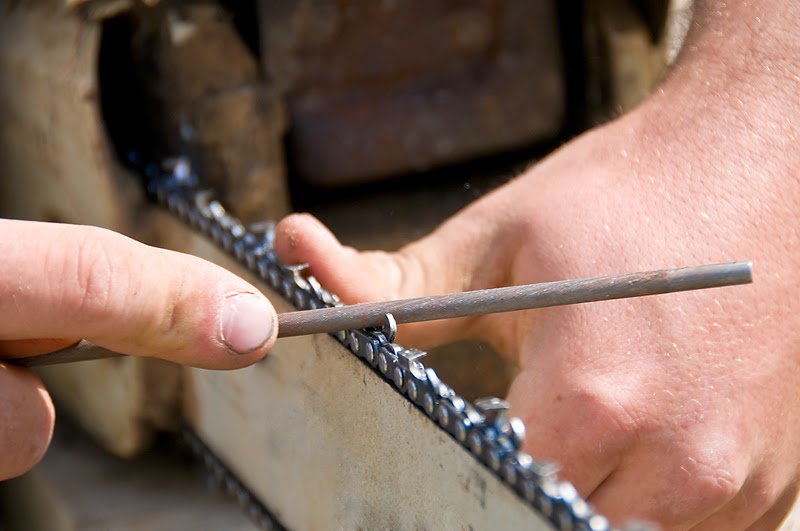
There are events held each year that pitch the best loggers and lumberjacks in the world against each other in competitions of speed, strength, precision, balance, safety, and just overall raw talent! All centered around the use of chainsaws, axes, saws, climbing gear and anything logging related.
For most competitors there are three main events you can compete in. In the US the biggest annual competitions are the STIHL Timbersport Series, and Lumberjack World Championships. In Europe it would have to be the biannual World Logging Championship. All consisting of their own individual, yet similar events.
Stihl Timbersport Series
Started in 1985 in Wisconsin, it is one of the most popular logging competitions today. It consists of six different disciplines with collegiate and professional divisions. The most recent championship was held on June 20th-22nd, 2014 in Norfolk VA, and featured athletes from all around the world.
The six events consist of:
- Springboard - An athlete cuts two notches in a 9 foot pole where they insert the spring boards that they use to climb up to chop off the top of the pole.
- Stock Saw - Competitors use identical Stihl chainsaws to make two cuts through identical logs marked by black lines.
- Underhand Block Chop - Standing on a log, the competitor uses an axe to chop it in half. They must make cuts from both sides.
- Single Buck - Using a single man cross cut saw, the athlete cuts through a piece of 18"-20" white pine. They can have a helper that lubricates the saw and wedges the wood.
- Standing Block Chop - Competitors use and axe to cut through a piece of white pine that is 12"-14" in diameter. They must cut the log from both sides.
- Hot Saw - In this event the competitors use custom saws with modified engines to make three cuts as fast as possible through the log.
Lumberjack World Championships
This is the oldest competition of the three and is the only one that involves climbing and log rolling events. It is also the only one that does not change locations. Held annually beginning in 1960 in Hayward, Wisconsin this event features men's, women's, and team divisions.
The list of singles events include:
- Underhand Block Chop - Same as above.
- Standing Block Chop - Same as above.
- Springboard - Same as above.
- Single Buck - Same as above.
- Hot Saw - Same as above.
- 60 and 90 Foot Speed Climb - Using climbing gear, the athletes scale the respective distance up a pole and then descend against time. Time starts at the "go" mark and is stopped when they return to the ground. The contestants must also touch the pole every 15 feet on the way down.
- Logrolling - Two athletes compete head to head in this event. Standing on a floating log each contestant tries rolling, stopping, or changing direction of the log to throw their opponent off balance and putting them in the water.
- Boom Run - Floating logs are set up end to end between two docks. The athlete then sprints to either end of the booms for the best time.
- Double Buck - Two contestants team up to use a two-man bucking saw to cut through a 20" white pine log as fast as possible.
- Jack and Jill - This is a double buck competition with a man and a women competing on the same team.
- Team Relay - Two teams race for time. Events include a 60-foot speed climb, 2 boom runners (one male, one female), hot saw, female single buck, and a standing block chop.
World Logging Championships
This event is held every two years in a different location around Europe. As opposed to the other two competitions, the WLC consists of 5 different disciplines mainly focus on chainsaw skills. The last event was held on September 10th-13th, 2014 in Brienz, Switzerland. The next event will not be held until 2016.
The 5 disciplines preformed in order include:
- Tree Felling - The competitor must fell a tree in three minutes towards a spot selected by said competitor. Points are awarded based on time, proximity to the selected target, and length and depth of the cut.
- Chain Fitting - In this timed event the competitor must remove the existing bar and chain, rotate the bar, replace the chain, and reassemble. The trick is though that the chain must be properly adjusted as the saw has to be used for the next two events. Points are deducted if they have to re-tension their chain.
- Combined Bucking - On a sloping log, the competitors cut two discs from the stump starting with an under cut. They then move to another log slopping in the opposite direction. Points are awarded for how straight and even the cuts are.
- Precision Bucking - This event requires the competitor to make as straight of a cut as possible without cutting into the wood situated under the log. Points are deducted based on angle of the cut and cutting into the wood underneath.
- Limbing - In the limbing competition the participants must saw off 30 limbs specifically placed on a 20-foot pole as fast and as close to the pole as possible. If the branch is left too long (5mm or more) or if they cut into the log (5mm or more), time penalties are assessed. Watch this video from the 2012 WLC limbing competition.
All of these competitions have team relay races, so if you got some buddies who you think could take on the best then you better call them up and get your names in. The Lumberjack World Championships requires that you have women on your team, so if you can find this girl you'll be better off -

So there you have it. If you think you are worth your salt as a logger, brush up on your chainsaw skills and get signed up for one, or all of these events!